
Quick answer: A well-engineered aluminum flood barrier is durable enough to hold back several feet of moving floodwater with significant margin to spare. Durability comes down to one comparison: the stress the floodwater puts into the barrier versus the yield strength of the alloy. Garrison's Hammerhead™ Aluminum Flood Plank System uses 6063-T6 aluminum with a yield strength of 145 MPa (roughly 21,000 psi). Independent Finite Element Analysis and Computational Fluid Dynamics studies by Predictive Engineering, sealed by licensed Professional Engineers, show peak stresses staying below that threshold across every configuration tested.
Aluminum gets questioned more than it should. People hear "aluminum" and picture a soda can rather than a structural extrusion. The relevant question is not what the metal feels like in your hand. It is whether the section geometry and alloy temper can carry the load a flood actually applies.
What Determines Whether a Flood Barrier Holds?
Three variables decide the outcome.
Water depth. Hydrostatic pressure grows linearly with depth, but total force grows with the square of depth. Double the water height and you roughly quadruple the load. Predictive Engineering verified this by hand for the models. At a 40-inch opening with water at 961.85 mm, pressure at the base calculated to 0.0094 MPa and total force to 4,610 N. The model returned 4,637 N, a match within 1 percent.
Span width. A wider opening means a longer unsupported plank and more bending stress in the middle. The same 5-plank configuration produced 23 MPa at a 40-inch opening and 112 MPa at a 10-foot opening, a nearly fivefold jump from width alone.
The connection hardware. As barriers get taller and wider, the governing stress often migrates out of the planks and into the brackets, posts, and anchors. Knowing which component governs is the difference between an engineered system and a guess.
How Strong Is the Material?
| Component | Material | Modulus E (MPa) | Poisson's Ratio | Yield Strength (MPa) | Ultimate Strength (MPa) |
|---|---|---|---|---|---|
| Planks | 6063-T6 aluminum | 70,000 | 0.33 | 145 | 186 |
| Posts | 6063-T6 aluminum | 70,000 | 0.33 | 145 | 186 |
| Brackets | 316L stainless steel | 200,000 | 0.29 | 215 | 505 |
| Leg support | 316L stainless steel | 200,000 | 0.29 | 215 | 505 |
| Seals | EPDM rubber | 16.50 | 0.49 | n/a | n/a |
What Did the Hydrostatic Testing Show?
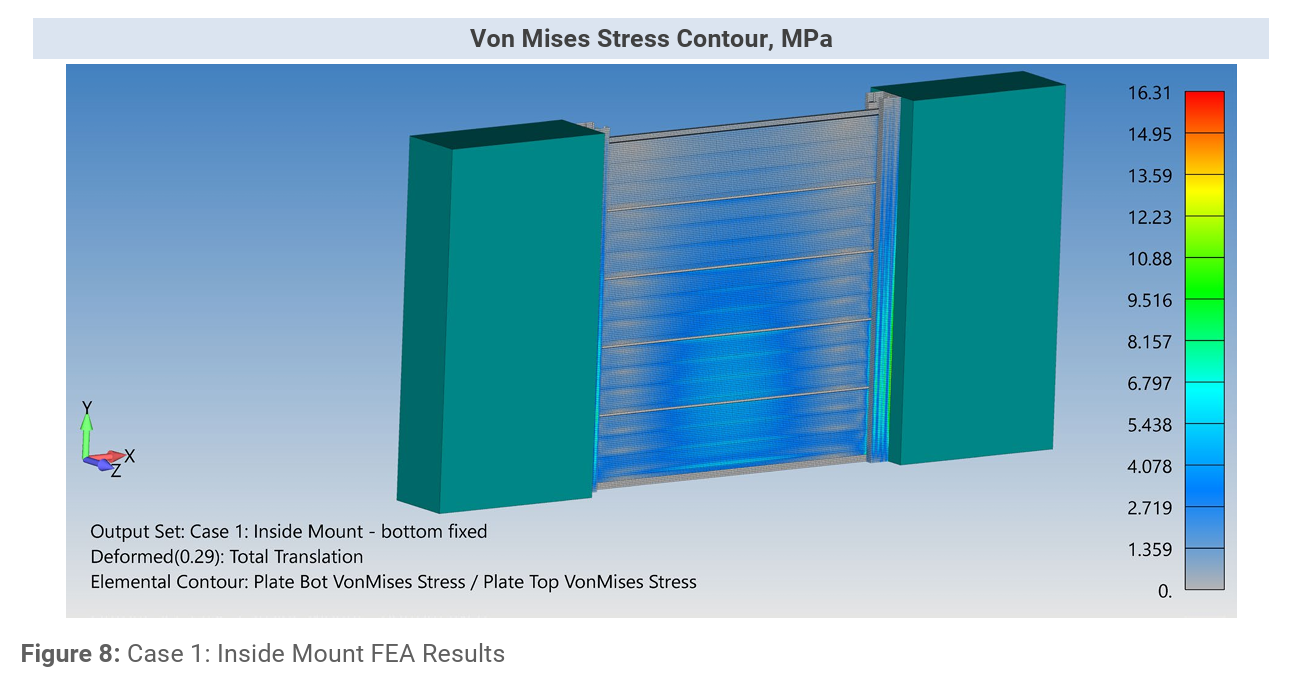
Predictive Engineering modeled the system in Simcenter Femap and Nastran across multiple opening widths, plank counts, and mounting configurations, assuming water at the full height of the barrier. Every configuration passed.
| Configuration | Opening Width | Planks | Max Stress (MPa) | Governing Location | Result |
|---|---|---|---|---|---|
| Inside mount | 1,020 mm (40 in) | 5 | 16 | Plank | Pass |
| Outside mount | 1,020 mm (40 in) | 5 | 23 | Plank | Pass |
| Outside mount | 1,020 mm (40 in) | 14 | 40 | Plank | Pass |
| Outside mount | 1,830 mm (6 ft) | 14 | 116 | Plank | Pass |
| Outside mount | 3,050 mm (10 ft) | 9 | 130 | Plank | Pass |
| With center post | 3,050 mm (10 ft) | 8 | 201 | Center post L-angle | Pass |
| Center post + leg support | 3,050 mm (10 ft) | 7 | 197 | Leg bracket | Pass |
Three findings deserve attention.
The first is the gap between inside and outside mounting. At the same 40-inch opening with the same 5 planks, inside mount produced 16 MPa and outside mount produced 23 MPa. The outside mount configuration runs slightly wider planks to overlap the opening, which adds span and therefore bending stress. Neither result is close to a problem, but it explains why Garrison's later testing focused on outside mount as the more demanding case.
Second, narrow openings are remarkably understressed. A 40-inch doorway stacked 14 planks tall reached only 40 MPa, about 28 percent of the aluminum's yield strength.
Third, adding a center post to a 10-foot span does not simply make the system stronger everywhere. It relocates the peak stress to the center post L-angle connection, which is 316L stainless with a 215 MPa yield. The analysis tracks that migration rather than assuming the planks always govern. For systems of 7 planks or fewer, running both a center post and a leg support distributes load more evenly and lowers peak plank stress.
FEA Results for 10-ft Wide 9-Plank tall System from the Max Height and Center Post report
What Happens When Water Arrives at Speed?
Standing water is the easy case. Real floods arrive as a moving front. Predictive Engineering ran a separate CFD study in Simcenter STAR-CCM+ using a multiphase volume of fluid method, with a 2.1 million cell trim mesh refined to 6.3 mm at the barrier face.
| CFD Parameter | Value |
|---|---|
| Barrier tested | 40 in wide x 104 in high, 14 planks |
| Inlet velocity | 2 ft/s (0.6096 m/s) |
| Velocity at impact | 8.2 m/s (27 ft/s) |
| Peak localized pressure | 38.8 kPa near the base |
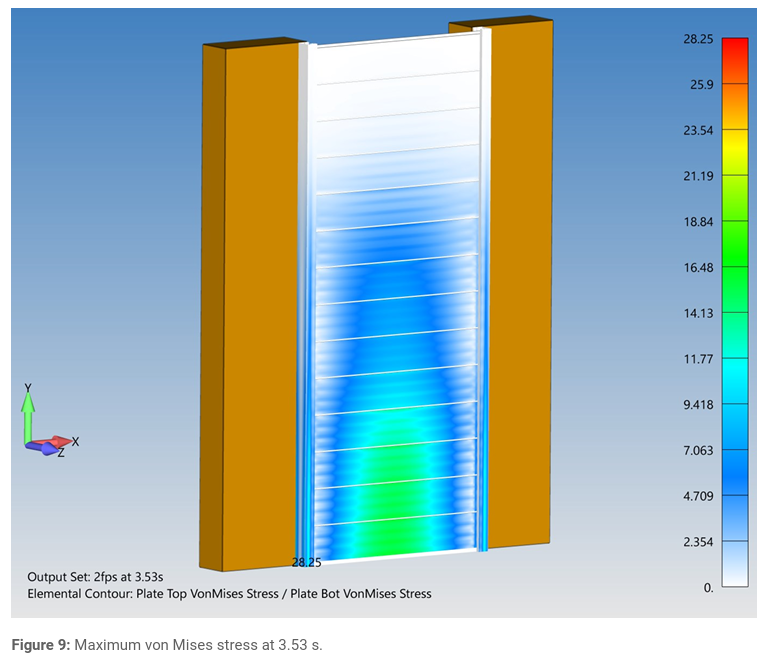
| Max stress at impact (1.84 s) | 17.1 MPa |
| Max stress at full water (3.53 s) | 28.3 MPa |
The detail worth sitting with: gravity accelerated the leading edge of the water to 27 ft/s before it struck the planks, more than thirteen times the inlet velocity. Even under that impact, maximum von Mises stress reached 28.3 MPa, which the report puts at roughly 20 percent of the yield strength of 6063-T6 aluminum. That leaves about a fivefold margin.
Durability Beyond the Stress Numbers
Structural capacity is one half of durability. The other half is what happens across years of storage, deployment, and salt air.
Aluminum forms a self-protecting oxide layer rather than rusting through, which is why it outlasts steel in coastal environments without coatings to maintain. Every bolt and bracket in the system is marine-grade 316L stainless, the same alloy specified for marine hardware. The sealing components are EPDM and closed-cell neoprene, materials selected for compression set resistance so they keep sealing after repeated cycles.
Operationally, the planks weigh about 2 pounds per linear foot, so a typical doorway plank is manageable by one person. They stack flat for compact storage and deploy by sliding into the U-channel posts and tightening down, which means unskilled labor can put the system up ahead of a storm. Nothing about the deployment process degrades the components, so the same planks go up season after season. Hammerhead barriers have come through multiple hurricane seasons in Florida coastal installations.
The practical maintenance item is not the aluminum. It is the caulk seal between the posts and the wall and ground, which should be inspected for cracking, drying, or gaps and re-applied when needed.
Full engineering documentation is available on the Hammerhead testing page, and system details are on the Hammerhead product page.
Frequently Asked Questions About Flood Barrier Durability
-
Yes. Hammerhead's 6063-T6 aluminum planks carry a 145 MPa yield strength. FEA testing across openings from 40 inches to 10 feet showed maximum stresses of 16 to 130 MPa, all below yield, with water at the full height of the barrier.
-
Hammerhead planks and posts are extruded 6063-T6 aluminum, specified in CSI Section 08316. It is chosen for its balance of extrudability, corrosion resistance, and structural strength.
-
Hammerhead is customizable to 6.5 feet, and higher with additional engineering. FEA testing established a ceiling of 14 planks for 40-inch and 6-foot openings, and 9 planks for a 10-foot opening without a center post.
-
Hammerhead planks span up to 12 feet without additional supports. Beyond that, center posts extend the system to unlimited length.
-
It allows longer spans and taller stacks, but it also shifts the peak stress into the center post L-angle connection. The FEA study found 201 MPa there on a 10-foot, 8-plank configuration, below the 215 MPa yield of the 316L stainless bracket.
-
CFD modeling at a 2 ft/s inrush produced water impacting the planks at 27 ft/s. Maximum stress was 28.3 MPa, about 20 percent of the material's yield strength.
-
Aluminum forms a protective oxide layer instead of rusting. Hammerhead pairs that with marine-grade 316L stainless hardware for coastal and salt-air environments.
-
Yes. Hammerhead planks stack flat for storage and are designed for repeated deployment and removal without degradation.
-
CSI Section 08316 calls for Finite Element Analysis confirming hydrostatic capacity, with reports showing maximum height and width capabilities at or above the project's opening size and Design Flood Elevation.
-
Predictive Engineering, Inc. of Portland, Oregon, with reports sealed by licensed Professional Engineers. The FEA used Simcenter Femap and Nastran, and the CFD used Simcenter STAR-CCM+.